Best GEO software for developer tool brands (2026): tracking what coding agents and AI assistants recommend
If you sell an API, SDK or dev tool, Codex, Claude Code and OpenCode now pick packages for your buyers. Eight GEO platforms reviewed on coding-agent coverage, crawler logs for docs, and API access.
Developer tools have two AI audiences, and most GEO software only watches one of them.
The first is the one every brand has: people asking ChatGPT, Claude, Perplexity or Gemini a question like "what's the best auth library for a Next.js app?" and reading the answer. The second is specific to you. A developer types "add a database to this app" into a coding agent, and the agent picks a product, installs the package and writes the integration. If your SDK is not the one it picks, the developer may never see a comparison page at all.
There is a third reader too: the agents that fetch your docs while answering. When ChatGPT-User or Claude-User pulls your quickstart in the middle of a conversation, that visit is part of whether you get recommended. And because your team is technical, you probably want this data in your own tooling through an API or MCP server, not only in a dashboard.
How we reviewed
We read the product and pricing pages of eight platforms, captured on November 6, 2026, plus our catalog entries. We didn't run any tool. We checked five things:
- Coding agent coverage. Does the vendor document tracking or testing Codex, Claude Code, OpenCode or similar agents?
- Assistant coverage, especially Claude, which developer audiences use heavily.
- Crawler data for docs. Can you see which AI bots fetch which pages?
- API and MCP access, and which plan it starts on.
- Traffic attribution from AI assistants to your site.
Where a page doesn't mention coding agents, we say "not documented". That is a statement about the page, not proof the feature is missing, so ask in the demo.
1. Promptwatch
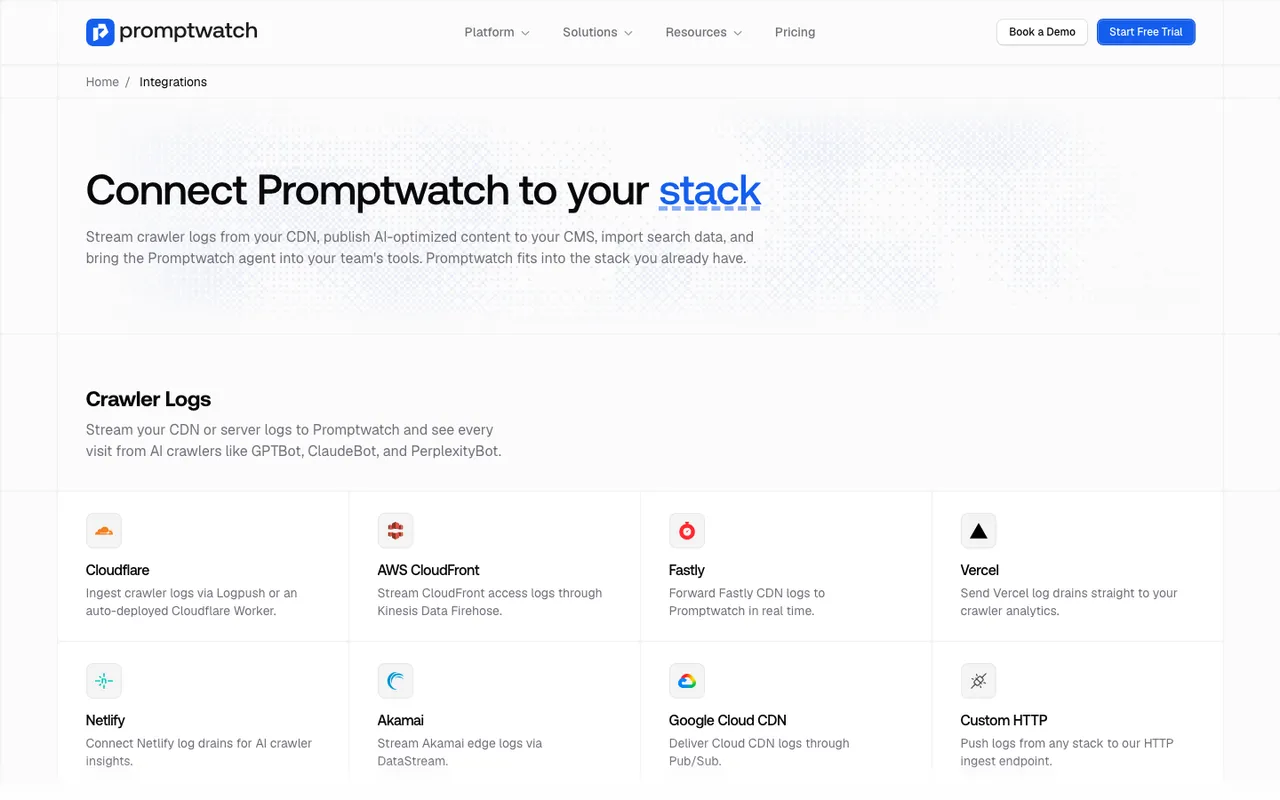 Promptwatch's integrations page, captured November 6, 2026.
Promptwatch is the platform we would put first for a developer-tool brand, because it covers all three readers in one workspace.
Coding agents. Promptwatch's pricing page lists Codex, OpenCode and Claude Code among its supported models, next to the chat engines. Its coding agent visibility tracks what those agents recommend: tools, libraries and docs. OpenCode searches the web through Exa, so it is worth reading its results with that in mind. Every paid plan can track any of the supported engines.
Assistants. ChatGPT, Perplexity, Gemini, Google AI Overviews, Google AI Mode and Copilot are monitored through their real interfaces. Claude, DeepSeek, Mistral and Grok are tracked through the API, which shows what those models answer from training data. Query fan-outs show the exact sub-queries each model ran behind an answer, which tells you what search terms your docs need to win.
Docs crawlers. Agent Analytics ingests logs from Vercel and Netlify log drains, Cloudflare, CloudFront, Fastly, Akamai, Google Cloud CDN, a custom HTTP endpoint or the WordPress plugin. Bots are IP-verified against each operator's published ranges, so a spoofed user agent doesn't count. The tracked list includes GPTBot, OAI-SearchBot, ChatGPT-User, ClaudeBot, Claude-User, Claude-SearchBot, PerplexityBot, Perplexity-User and MistralAI-User. Each page gets a citation rate, and failed fetches come with an explanation, which matters when an agent hits a renamed docs URL.
Traffic. Visitor Analytics counts AI-referred visits and conversions from ChatGPT, Claude (claude.ai and claude.com), Perplexity, Copilot, DeepSeek, Mistral and others. Since ChatGPT stopped sending a referrer on October 8, 2026, a toggle counts utm_source=chatgpt.com visits as ChatGPT again.
Developer access. The hosted MCP server at https://server.promptwatch.com/mcp has 110+ read and write tools, authenticates with OAuth or an API key, and works with Claude, Claude Code, ChatGPT, Cursor (one-click install), Lovable and Codex. REST API v2 lives at https://server.promptwatch.com/api/v2 with an X-API-Key header, date ranges up to 92 days, and keys scoped to a project, an organization or read-only. MCP and API are on every paid brand plan, with rate limits of 500 requests an hour on Essential, 2,000 on Professional, 10,000 on Business and 50,000 on Enterprise.
Limits: crawler logs start on Professional ($245 a month). Essential ($95) gives you prompt tracking, visitor analytics and the API, but not Agent Analytics. The automated Content Agent, which can write and publish articles against visibility gaps, starts on Business ($579).
2. Gauge
 Gauge's homepage, captured November 6, 2026.
Gauge is the one other platform here built with developer tools in mind, and it approaches coding agents differently. Its Gauge Agents product runs controlled tasks against coding agents (Claude Code, Codex, OpenCode, Pi and Antigravity, per its FAQ) to measure two things. "Agent preference" is which product an agent picks for a task. "Agent experience" is whether the agent can actually use yours: it runs real coding tasks, records session traces, and lets you test docs or skill changes against a baseline. It can also run evaluations as GitHub PR checks and test your MCP server.
You can start locally with the open-source Gauge CLI, in Docker, using your own Claude Code or Codex subscription. The hosted version has a free starting allowance (the FAQ mentions both 500 credits refilling to 100 a week and 1,000 free credits, so confirm which applies) and a Pro plan at $499 a month for 5,000 credits. Gauge's own FAQ notes that evaluation results show behavior in the tested conditions, which is not the same as live customer usage.
Its AI visibility product, Gauge Chat, is priced separately: Growth is $599 a month for 600 prompts run daily on ChatGPT, Google AI Mode and Microsoft Copilot, with 18 articles and 3 seats. AI crawler monitoring connects through Cloudflare and Vercel.
Limits: two products, two bills. The Growth AEO plan does not cover Claude or Perplexity. Our catalog doesn't document visitor analytics that attribute AI-referred traffic to conversions.
Who it suits: DevRel and product teams that want to test whether an agent can integrate their SDK, and fix the docs when it can't. It pairs well with a live visibility platform.
3. AthenaHQ
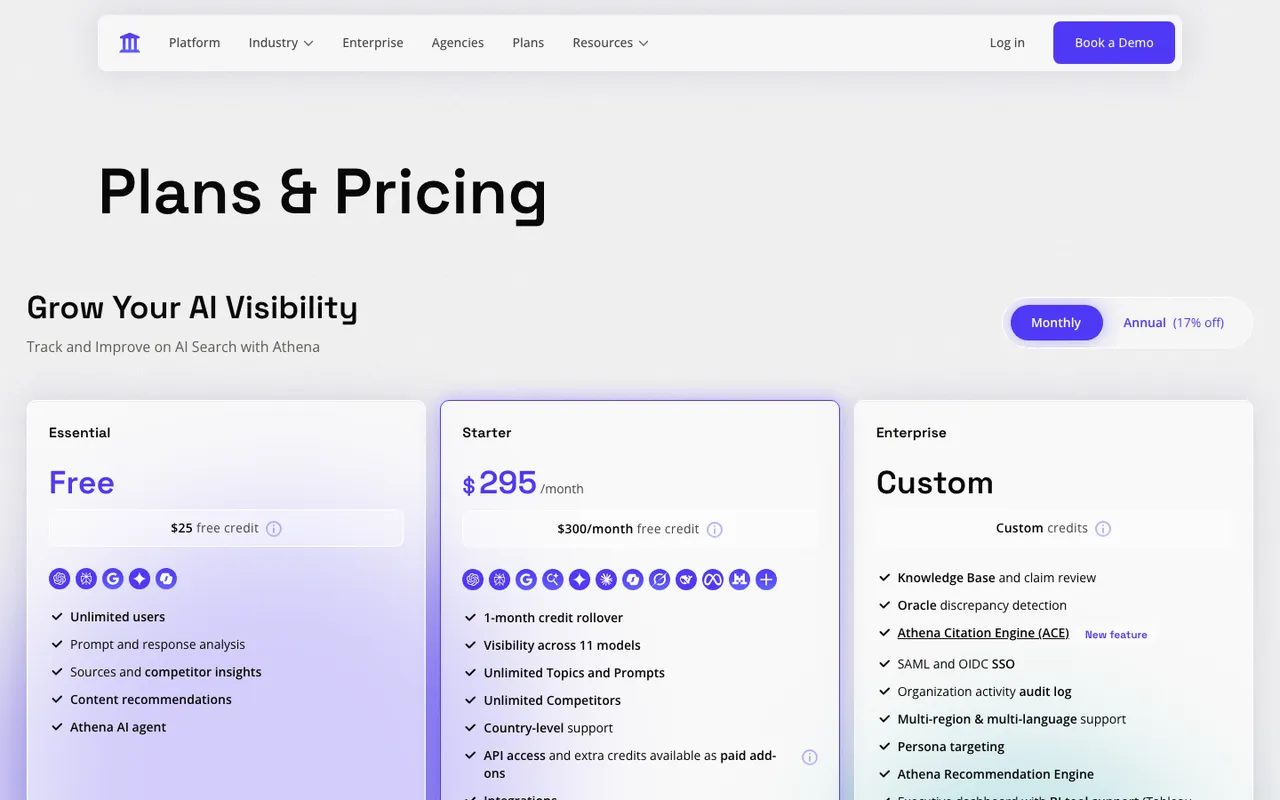 AthenaHQ's pricing page, captured November 6, 2026.
AthenaHQ Starter ($295 a month, 3,600 credits) covers 11 models: ChatGPT, Perplexity, AI Overviews, AI Mode, Gemini, Claude, Copilot, Grok, DeepSeek, Meta AI and Mistral, with more on request. That is good Claude coverage on a self-serve plan. The feature table lists smart robots.txt and llms.txt management for AI crawler access, and GA4 and Search Console integrations.
Limits: coding agents are not documented. API access on Starter is a paid add-on priced on request. No page-level crawler log product is documented in our catalog.
4. Scrunch AI
 Scrunch's homepage, captured November 6, 2026.
Scrunch AI is relevant to dev-tool brands with JavaScript-heavy docs. Its Agent Experience Platform (AXP) serves AI-optimized versions of pages to agents, and Core ($250 a month) includes AI agent and bot traffic reporting.
Limits: Core tracks ChatGPT, Perplexity, Google AI Overviews and Copilot. Claude, Gemini and Grok are on Enterprise, as are AXP, the query API and MCP access. Coding agents are not documented.
5. Profound
Profound Enterprise lists capability for ChatGPT, Perplexity, Google AI Mode, Gemini, DeepSeek, Anthropic Claude, Google AI Overviews, Exa Search and Muse Spark. Its Agent Analytics tracks AI-sourced traffic with integrations including Vercel, Netlify, Cloudflare, Fastly, AWS and Akamai, and the API is on Enterprise.
Limits: the self-serve path is a 7-day trial on three engines; everything else is a custom Enterprise contract. Coding agents are not documented.
6. Rankshift
Rankshift tracks all supported LLMs on every plan, including Claude, Mistral, Grok and DeepSeek, with unlimited seats and projects. Its homepage shows an Agent Analytics view of GPTBot, ClaudeBot, ChatGPT-User and PerplexityBot visits, including a /docs/tracking path in the example. In the pricing screenshot, crawler analytics and MCP and API access are ticked from Professional (€159 a month billed annually, as shown to a Netherlands visitor) and greyed out on Starter.
Limits: coding agents are not documented, and the depth of the crawler analytics isn't described.
7. LLM Pulse
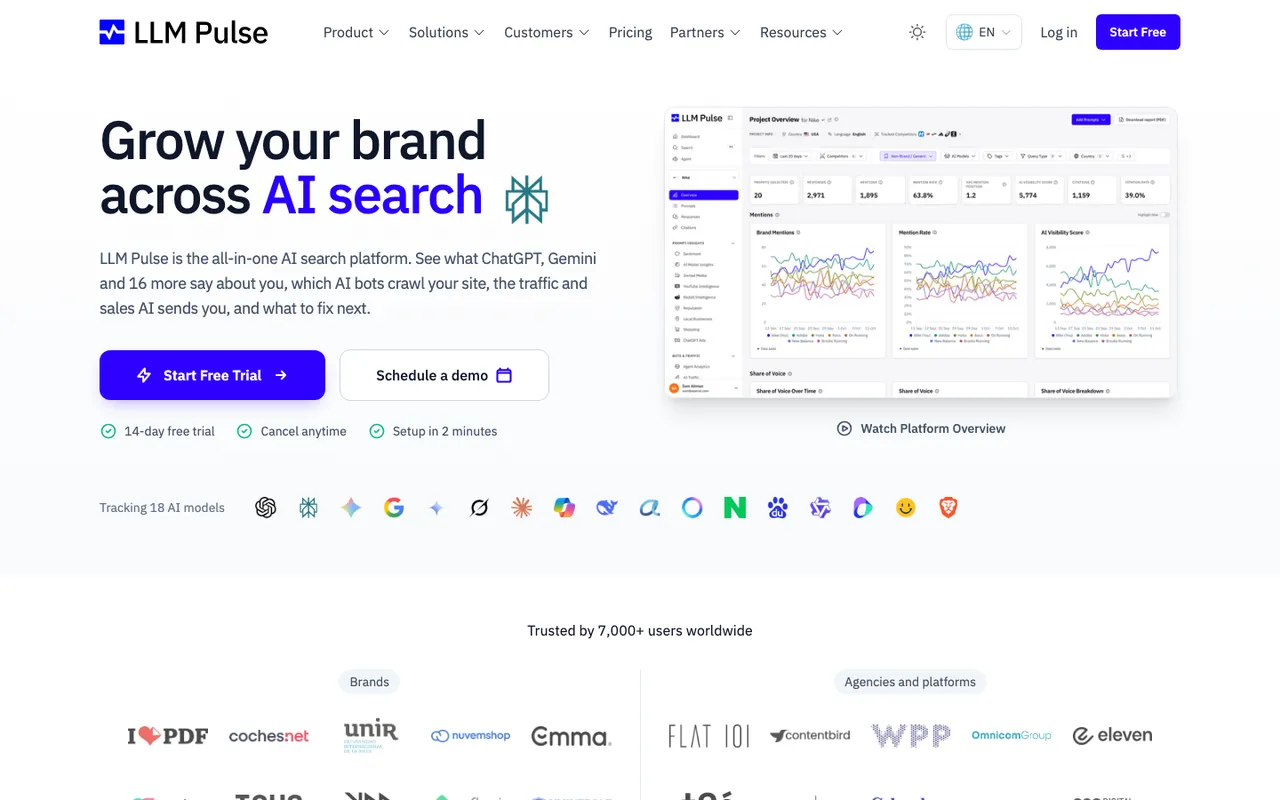 LLM Pulse's homepage, captured November 6, 2026.
LLM Pulse has the most developer-friendly access at the low end: an MCP server "for ChatGPT, Claude, Cursor & more" on every plan, and a REST API and CLI from Scale (€299 a month). Its homepage lists GPTBot, ClaudeBot, PerplexityBot and OAI-SearchBot in an Agent Analytics view, and says it can bring in CDN logs.
Limits: five models are included (ChatGPT, Perplexity, Google AI Mode, AI Overviews, Gemini); Claude is a paid add-on. Weekly is the default tracking cadence. Agent Analytics is listed per-URL from Scale. Coding agents are not documented.
8. Rankscale
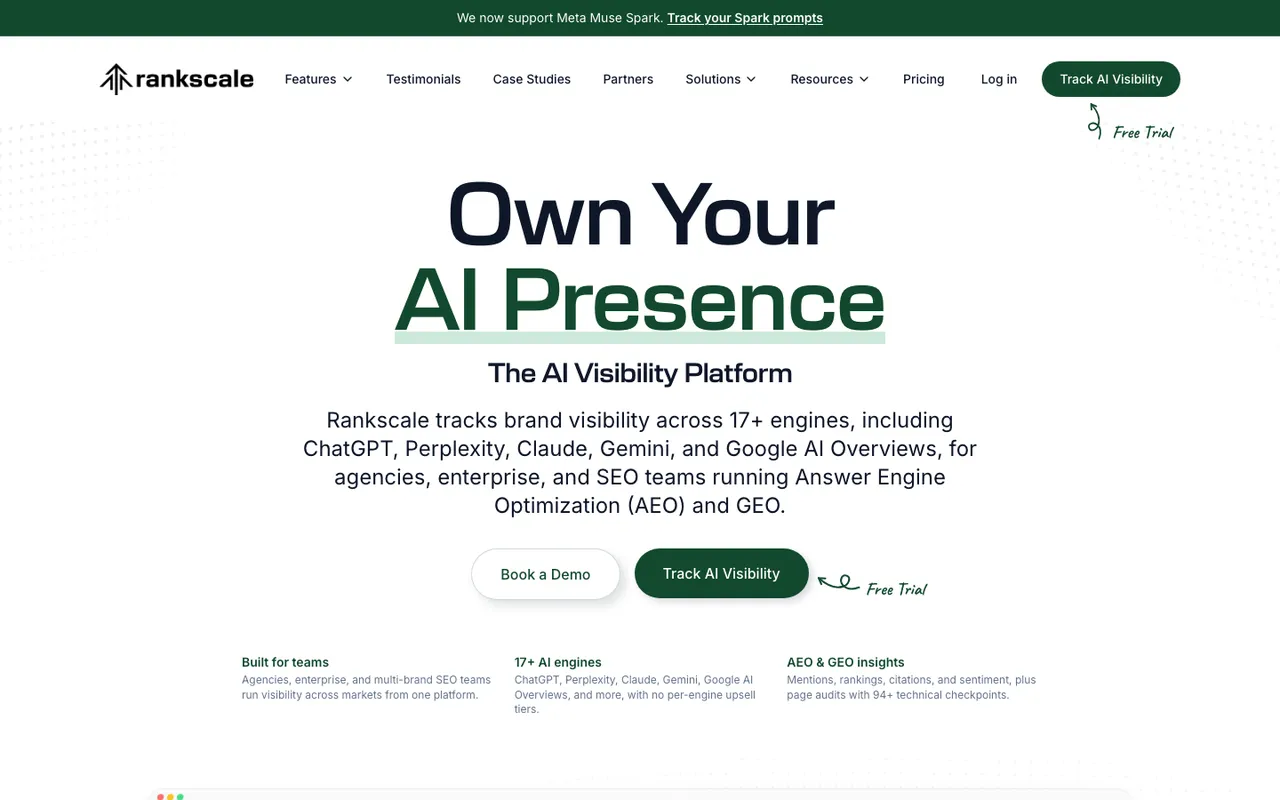 Rankscale's homepage, captured November 6, 2026.
Rankscale covers 17+ engines on every plan, and its credit calculator lists API engines such as Claude, GPT and Mistral Large alongside the consumer interfaces. MCP is included on every plan, and the REST API starts on Pro+ ($229 a month in our catalog). Its pages describe auditing AI bot crawlability; we found no log ingestion documented.
Limits: coding agents are not documented, and Claude costs 2 credits per run against 0.25 for ChatGPT.
Comparison table
| Tool | Coding agents | Claude coverage | AI crawler logs | API / MCP |
|---|---|---|---|---|
| Promptwatch | Codex, Claude Code, OpenCode (live recommendations) | Via API | IP-verified, from Professional | Both, every paid plan |
| Gauge | Claude Code, Codex, OpenCode, Pi, Antigravity (controlled evaluations) | Gauge Chat lists Claude; not on Growth | Via Cloudflare or Vercel | MCP and CLI |
| AthenaHQ | Not documented | Starter | Not documented | API as paid add-on |
| Scrunch AI | Not documented | Enterprise | Bot traffic on Core | Enterprise |
| Profound | Not documented | Enterprise | Agent Analytics | API on Enterprise |
| Rankshift | Not documented | Every plan | From Professional | From Professional |
| LLM Pulse | Not documented | Paid add-on | Per-URL from Scale | MCP every plan; API from Scale |
| Rankscale | Not documented | Every plan (2 credits) | Crawlability audit; logs not documented | MCP every plan; API from Pro+ |
Who should pick which
- You want live coding-agent and assistant recommendations, docs crawler logs and traffic in one place: Promptwatch, on Professional or higher.
- You want to test whether agents can integrate your SDK: Gauge Agents, ideally next to a live tracker.
- You want broad Claude and Grok coverage on a self-serve plan, and an action queue: AthenaHQ.
- Your docs are JavaScript-heavy and agents misread them: Scrunch AI's AXP, on Enterprise.
- You want cheap MCP access to pull data into Cursor or Claude: LLM Pulse or Rankscale.
Our recommendation
For a developer-tool brand, the useful question is not "are we mentioned?" but "which agent picked whom, which docs page did it read, and did that turn into a sign-up?" Promptwatch answers all three in one place. Coding agent visibility shows what Codex, Claude Code and OpenCode recommend. Agent Analytics shows which docs pages ChatGPT-User and Claude-User fetched, with a citation rate per page. Visitor Analytics shows the visits that came from claude.ai or chatgpt.com and what they did next. And because the MCP server works in Claude Code and Cursor, your engineers can query it from where they already work.
Start the 7-day free trial on Professional, connect your Vercel or Cloudflare logs, and add the ten prompts your docs should win, phrased the way a developer would ask a coding agent. Our earlier piece on what Codex, Claude Code and OpenCode recommend has prompt ideas, and the Promptwatch MCP server and REST API guide covers the integration side.
FAQ
Can GEO software track what Claude Code or Codex recommends?
Two platforms in this review document it. Promptwatch lists Codex, Claude Code and OpenCode among its supported models and tracks what they recommend. Gauge runs controlled tasks against Claude Code, Codex, OpenCode and others to measure which product they choose and whether they can use it.
What is the difference between tracking and evaluating a coding agent?
Tracking records what an agent recommends when asked, the way you would track a ChatGPT answer. Evaluating runs the agent through a real task, such as installing and using your SDK, and records whether it succeeds. Both are useful; they answer different questions.
Why do crawler logs matter for docs?
Assistants and coding agents fetch docs pages while answering. Logs show which bots read which pages and where they hit errors. A docs page that agents fetch but never cite usually needs clearer content; one they never reach usually has an access or routing problem.
Which tools offer an MCP server?
Among the tools in this review: Promptwatch (every paid plan), LLM Pulse (every plan), Rankscale (every plan), Rankshift (from Professional), Gauge, and Scrunch (custom on Enterprise).