GEO tools for enterprise content teams in 2026
GEO tools for enterprise content teams that publish at scale with governance: content from visibility gaps, approval inboxes, brand rules, CMS publishing, page refreshes and proof that pages get crawled and cited.
Enterprise content teams don't lack writing capacity anymore. Any team can generate a hundred drafts by Friday. What they lack is a reason to publish each one, a review step that legal and brand will sign off on, and any evidence afterwards that the page did something in AI search.
That gap is the right lens for judging GEO tools for enterprise content work. On one side sit AI writers with no visibility data, which produce articles nobody asked an AI engine about. On the other sit visibility dashboards with no publishing, which produce a backlog. The tools worth paying for at enterprise scale connect the two and put governance in the middle.
Our broader GEO tools for content teams guide covers smaller teams. This one is about publishing at volume under rules. Competitor details come from our catalog entries, mostly read from vendor pages in late October 2026, and anything a vendor doesn't publish is marked as such.
What governance means for AI content at scale
Five things separate an enterprise content workflow from a writer with a subscription.
The brief should start from a measured gap. A prompt where competitors are cited and you aren't, or a sub-query an engine runs that none of your pages answer. Topics picked from a brainstorm are how teams end up with 300 articles and no movement.
There should be a human approval step, and it should be optional per stream. A regulated product page needs review. A refresh of a glossary entry may not. One global setting for everything forces you to choose between slow and risky.
Brand rules have to live where the generator reads them. Tone of voice, banned claims, product facts and author profiles in a PDF on a shared drive don't count.
Publishing should land in the CMS you already run, as a draft or live, without someone pasting HTML.
And the loop has to close. After a page goes live, you need to know whether AI crawlers fetched it, whether engines cite it, and whether it sends visitors. Without that, the next content plan is a guess again.
1. Promptwatch
Promptwatch is the only tool on this list that covers all five in one product, which is why it ranks first for enterprise content teams.
Briefs start from data. Content gap analysis with coverage scores is on every plan, and Answer Gap tasks have a "Create content" action. Content Creation can write about any topic, any tracked prompt, any query fan-out or any page that engines cite, from a brief that pulls in your branding, Google results, news, internal links, YouTube transcripts, live page screenshots and up to five competitor URLs. It picks internal links before it writes, favoring pages with many Search Console impressions but few clicks, which is a sensible way to spend link equity.
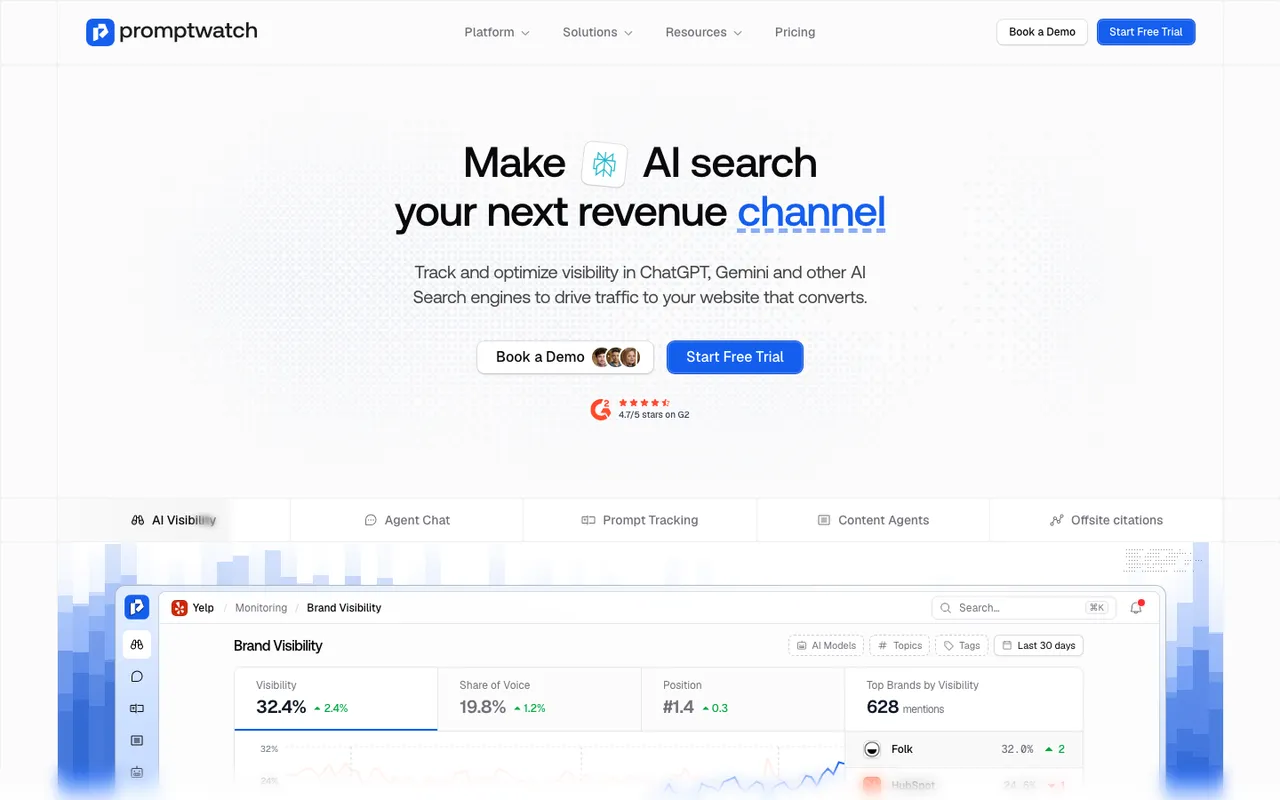 Promptwatch homepage, captured November 6, 2026.
Brand rules are built in. A Brand Book and tone of voice, author profiles and meta titles shape every draft, and the Knowledge Base holds product facts the writer should use: 100 items on Professional, 150 on Business. Content is written in the prompt's language, so a French gap gets a French draft. Each document carries a "How this content was created" note, which gives a reviewer the sources behind a draft before they approve it. The editor has AI image generation and a side panel for AI edits that you can revert.
The approval model is the part that suits enterprise teams best. The Content Agent, on Business and Enterprise, plans, writes and publishes against visibility gaps on a schedule, with a publishing calendar, a monthly budget and publish windows. Drafts go to a review inbox where an editor approves, edits or declines them, or you can switch a stream to fully automated mode. Enterprise adds managed content workflows. The audit log on Business and Enterprise shows whether a change came from the dashboard, the API, an MCP client or Agent Chat, and owner, editor and viewer roles keep reviewers from publishing by accident.
Publishing covers WordPress, Webflow and Framer. WordPress uses an official plugin that connects with your site URL and a sync token, with no API keys stored in wp-admin, and the same plugin captures crawler logs and visitor analytics. Webflow connects through OAuth, you map fields once, localized collections are supported, and publishing live pushes only that item without a site-wide rebuild. Framer takes a project URL and an API key and receives content as markdown. AI field mapping fills custom fields. Content can go out as a draft or live, manually or through the Content Agent.
Existing pages get attention too. Content Refresh suggests diff-style updates to pages you already have, and pages that underperform come back as Action Board items. That matters because AI citations decay. Promptwatch's own data reports found that news loses half its ChatGPT citations within about 36 days.
Then the loop closes. Publish status tracking follows each document from draft to live URL and then through AI crawls, citations and AI-referred traffic. Agent Analytics, from Professional, shows IP-verified visits from bots such as GPTBot, OAI-SearchBot, ClaudeBot and PerplexityBot with a citation rate per page, so you can tell a page that was never crawled from a page that was crawled and ignored. Page Tracker follows specific URLs in AI answers. Visitor analytics attribute AI-referred visits to conversions. Crisp, one of Promptwatch's published case studies, scaled to 5 to 10 articles a day with a focus on the Reddit and YouTube sources engines cite, and its AI-referred traffic converted at twice the rate of traditional channels.
The plan gating is worth getting right before the business case. Essential has no AEO articles and no Knowledge Base. Professional, at $245 a month, includes 5 AEO articles (with add-ons up to 50) and crawler logs. Business, at $579 a month, includes 10 AEO articles (add-ons up to 125) and the automated Content Agent. The self-serve agency plans don't include AEO articles, the Knowledge Base or the Content Agent.
2. AthenaHQ
AthenaHQ turns visibility gaps into on-page and off-page actions through its Action Center, and Starter at $295 a month includes a content optimization agent. The pricing page lists Shopify and Webflow integrations and Google Analytics and Search Console connections. For a content team that wants a prioritized queue, it works.
The governance questions are where the listing goes quiet. Our entry doesn't document a scheduled publish-to-CMS workflow with a review inbox, and its cons note that recommendations still need editing before they ship. SSO and an audit log are on the custom Enterprise tier. Ask to see the path from a recommendation to a published page, with approvals, on your own CMS.
3. Scrunch AI
Scrunch AI isn't a writing tool, but content teams should know what it does. Its Agent Experience Platform serves AI-optimized versions of pages to AI crawlers without changing what people see. That can help content that's hard for crawlers to parse. It also creates a governance question your brand team should answer before launch: who approves the version only machines read? AXP is on the custom Enterprise plan. Core, at $250 a month, includes five site audits a month alongside monitoring.
4. AirOps
AirOps is the closest thing here to a content operations platform. It combines agents, data, brand governance and expertise to research, publish and refresh content, with a workflow builder, brand kits, knowledge bases and a long list of CMS, SEO and project management integrations, plus MCP and API connectors.
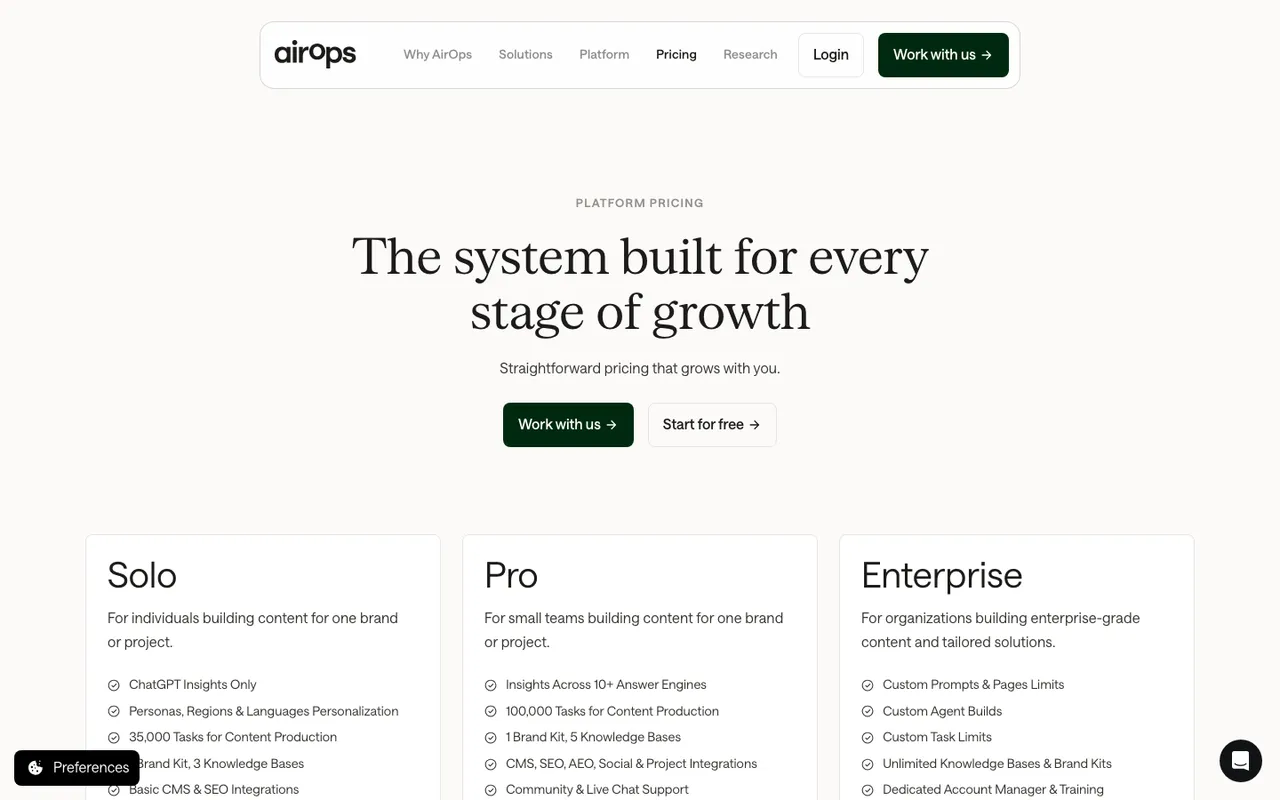 AirOps pricing page, captured November 6, 2026.
Solo gives 35,000 tasks, ChatGPT insights only and a single user. Pro gives 100,000 tasks, insights across seven or more answer engines and unlimited seats. Enterprise is custom with unlimited knowledge bases and brand kits and a dedicated account manager. The page didn't show dollar prices for Solo or Pro when we read it. The trade-offs are real: task-based billing is the most common complaint in our entry, it's a workflow builder with a learning curve, and it doesn't replace prompt tracking, citation analytics or crawler logs. A team that uses AirOps for production will still want a measurement platform next to it.
5. Goodie
Goodie sells a closed-loop AEO platform. Its agents write and optimize content, fix technical signals such as llms.txt and sitemaps, and handle outreach, and an MCP server comes on every plan.
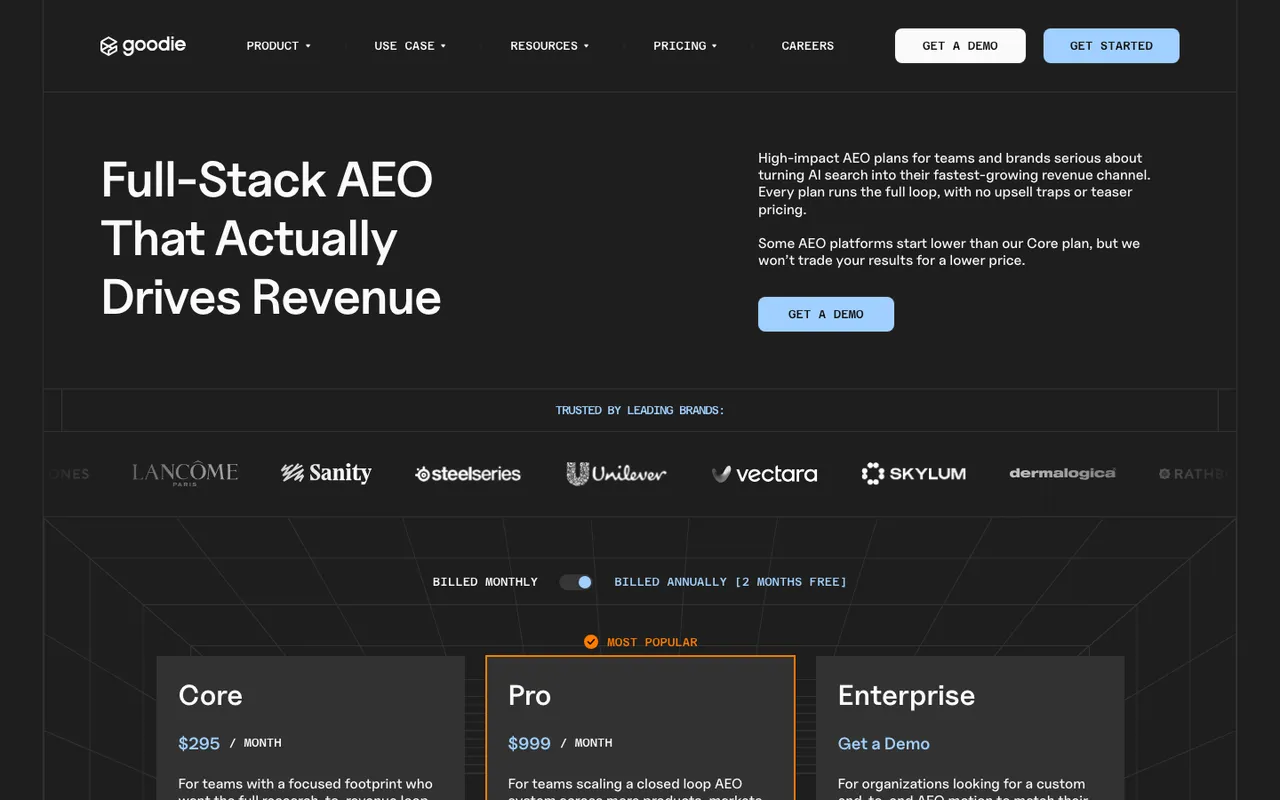 Goodie pricing page, captured November 6, 2026.
Core is $295 a month for five models, 110 prompts, one brand, two countries, 50 optimization actions a month and unlimited seats. Pro is $999 with eight models, 250 prompts, five countries and 100 actions. Enterprise is custom, with up to 14 models, revenue attribution, SSO and SOC 2. The action allowance is the number to model, because at enterprise volume 50 or 100 optimizations a month runs out quickly. Our entry notes that independent reviews are few, and the listing doesn't document visitor analytics tied to conversions.
6. Profound
Profound markets an AI Marketer with agents for research, content, reporting and workflows, running on credits. Enterprise is custom with up to nine answer engines, SSO and SOC 2. For a content team, the agent approach can work if you want a broad marketing assistant. Our listing doesn't document CMS publishing with a review inbox or page-level tracking of what happens after publication.
7. Writesonic GEO
Writesonic GEO bolts AI search tracking onto an AI writing and SEO platform. The self-serve plans, billed annually, run from $79 a month (50 prompts, 15 articles, one user) to $399 (200 prompts, 50 articles, three users, two projects). They track ChatGPT, Gemini and Google AI Overviews.
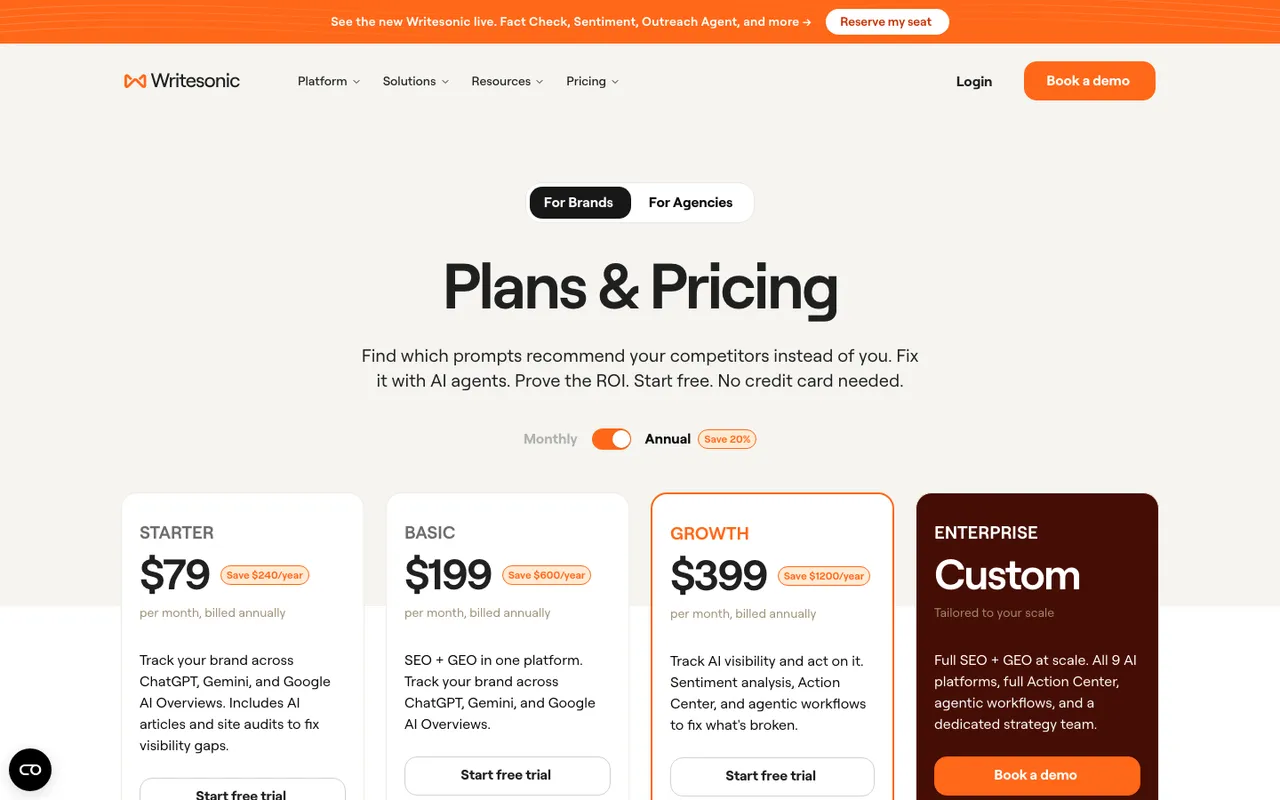 Writesonic GEO pricing page, captured November 6, 2026.
The enterprise problem is the split. The full Action Center, coverage of all nine AI platforms, SSO and SOC 2 Type II are Enterprise only, and Enterprise is custom. Extra users cost $50 a month on Basic and Growth, which adds up for a large editorial team. It suits a team that mainly wants articles. It falls short for a team that has to prove what those articles did.
8. Conductor
Conductor is the incumbent choice for content teams already inside an enterprise SEO suite. It puts GEO recommendations into content briefs and includes workflow, tasks and approvals. Writing assistant drafts are capped by tier: 60 a year on Essentials, 180 on Growth and 600 on Enterprise. Prices aren't published. Our listing documents no crawler-log product and no publishing agent.
Comparison table
| Tool | Where content starts | Approval step | Brand controls | CMS publishing | After publishing |
|---|---|---|---|---|---|
| Promptwatch | Visibility gaps, prompts, fan-outs, cited pages | Review inbox or automated mode | Brand Book, tone of voice, Knowledge Base, author profiles | WordPress, Webflow, Framer | Crawls, citations and AI traffic per page |
| AthenaHQ | Action Center gaps | Not documented | Not documented | Shopify and Webflow integrations listed | GEO score |
| AirOps | Workflows you build | Not documented | Brand kits, knowledge bases | CMS integrations | Not documented |
| Goodie | AEO agents | Not documented | Not documented | Not documented | Citation lift tracking |
| Writesonic GEO | AI article writer | Not documented | Not documented | Not documented | Tracking on three engines self-serve |
| Conductor | Briefs with GEO recommendations | Workflow, tasks, approvals | Not documented | Not documented | AI visibility next to SEO metrics |
A governance model that holds up
Split content into streams by risk. Product, pricing and regulated pages always get human review. Supporting explainers and refreshes can run on a lighter review or on automation once the first few batches look right. In Promptwatch that maps to separate Content Agent schedules, some reviewed in the inbox and some fully automated.
Write the brand rules once, in the tool. Put tone of voice and author profiles in the Brand Book, and product facts in the Knowledge Base, and treat them like code: one owner, a change log, and a review when the product changes. Fact Check, on Business and Enterprise, helps here because it checks the claims AI engines already make about you against your own crawled pages, so you know which facts your content needs to state plainly.
Set a budget, not a quota. A monthly content budget with publish windows keeps the agent from flooding the CMS during a launch freeze.
And judge every batch on what happened to it. Did the crawlers come? Did any engine cite the page? Did it bring visitors who converted? Pages that fail all three are usually better refreshed than replaced.
The recommendation
Enterprise content teams need a publishing system tied to a measurement system, with an approval step in between. Promptwatch is the one tool here that ships all of it: briefs from measured gaps, a review inbox, brand rules the writer reads, publishing to WordPress, Webflow or Framer, and page-level proof through crawler logs, citations and visitor analytics. Start the 7-day free trial on the Business plan from the Promptwatch pricing page and run one content stream end to end, or read our Promptwatch review first.